
Previous Post
Hurricane Season 2026: A Quieter Forecast, But Preparation Still Matters

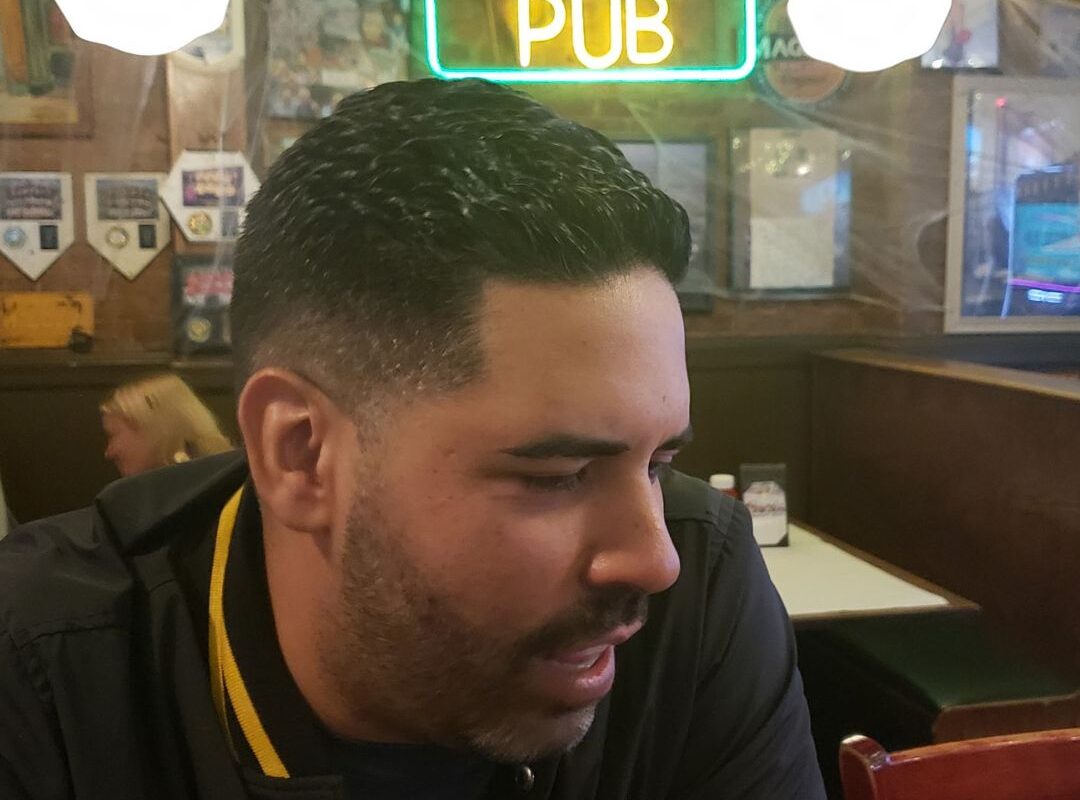
You can learn a lot about Abel Mendoza online.
You can learn that he grew up in Añasco, and is a rum and cigar lover who collects vinyl and cookbooks. You’ll read that he studied at the Culinary Institute of America in Hyde Park. He cooked in Peru, San Francisco, Los Angeles, and Portland, and worked in one of the top restaurants in the world.
You’ll find that he was the first chef from western Puerto Rico to receive a James Beard nomination and that he won back to back Lazos de Oro among other awards. He is currently the executive chef and a partner at Estela restaurant in Rincón.
You can learn all of that in less than five minutes.
What you can’t find online is Abel on a Sunday afternoon drinking a bottle of Txakoli Rosé, smoking cigarettes, while cars pass by with music blaring. In fact, most Sundays, you won’t find him out at all. Maybe on a Monday, and definitely not in the places you would expect of a world-class, award-winning chef.
This is not an interview. There are no prepared questions. It could have been in a dive bar in East LA where the beer is barely cold or a cigar smoke filled room in Havana. But on this day, there was wine, there was conversation, and there was Abel.
“People always show up with a list of questions,” he says. The questions are things they could have Googled. He has answered them before and there is really no need to ask them again. There was no need to ask about his awards. All of those awards, by the way, are still sitting in the cardboard boxes they arrived in. Not hanging on the wall at home or displayed at the restaurant. Just sitting in boxes.
Abel is good. He knows it. He just doesn’t care much to talk about it.
“My awards are the guests. The ones who work all week and choose to spend their money and their evening here, and let me feed them what I want to feed them. That’s the real award. The rest is just a compliment.”
Emphasis: he feeds them what he wants to feed them. Abel’s kitchen and restaurant are not democracies. The menu isn’t a negotiation.
Neither is the cost of running a restaurant in western Puerto Rico. Fresh ingredients are harder to source here than most people realize. The logistics are real. The margins are thin. Abel knows exactly what it costs to do things the way he wants to do them. And he’s fine if not everyone agrees. If a customer complains about prices or menu choices. Abel isn’t interested in arguing. If you don’t like it, there are plenty of other restaurants.
He is extremely intelligent, well-read, and vulgar in the best way. Some people will find Abel abrasive. Others will find him hilarious. Most will find him impossible to figure out. Both are real. You just have to sit with him long enough to see that there’s no black and white.
As we chat, Abel talks about someone famous who recently wanted to buy out the restaurant for the night. A private evening. An open checkbook, whatever the number. Abel declined.
He had regulars with reservations; people who had planned their week around this dinner. He was not going to cancel them.
As the wine and conversation flowed, two different people passed by asking for money. One with a basket full of treats to sell, the other with a collection jar. Both with a story. They were the kind of encounters we’ve all seen before. Abel listened and then opened his wallet both times.
The man who turns down celebrities and tells entitled customers to find another restaurant opens his wallet without a second thought for someone who needs it.
We talked about whether cooking is an art. Abel doesn’t think so. Not really. The creation might be art, but execution is something else. It’s skill and discipline. It’s not something mystical, but a craft.
By this point, talk about food is almost incidental. Food becomes music. Music becomes philosophy. Philosophy becomes stories. We just talked. About everything and nothing. At some point, mid-story about his time in LA, a photo comes out. Abel and Ron Jeremy. It is one of many stories from one of many places. Beatles or Rolling Stones? Definitely the Stones. Although he gives credit to the Beatles for what they have achieved. For hours, it goes like this.
We talked about politics. He doesn’t believe in democracy, by the way. We talked about life and death. Abel is not afraid of dying. Getting old is a little more scary. He’s not afraid of prison, except that they might make someone else executive chef and he would have to eat their crappy food for the next ninety nine years. Half joke. Half not.
There was a time in Peru when people flew in specifically to eat his food. He was cooking at one of the best restaurants in the world. He left. He’s been to San Francisco, Los Angeles, and Portland. He knows exactly what the world looks like from inside a kitchen that the world is paying attention to.
But, for now, he has chosen Rincón. That choice sits at the center of everything complicated about Abel Mendoza. Cooking here is not romantic. Western Puerto Rico is not a supply chain built for the standards a chef like Abel holds himself to. But he is not here because he doesn’t know what else is out there.
At some point he talks about exit plans. Hiding places. Spots in the world where he could disappear and no one would find him. Then he jokes about going out Departed style. There is something in the way he says it. Not sadness. Not bravado. Something harder to name.
Hours pass, more wine, more conversation. And without realizing it, afternoon turns into night. So what comes next is an attempt to squeeze in whatever we can before the night ends. There’s still so much more to talk about, so many questions. Not because the questions matter, but because the answers are never what you expect.
Favorite album of all time? He refuses to pick one. Instead, three: Secreto by Facundo Cabral. Ziggy Stardust by David Bowie. Anything by Silvio Rodríguez. Then he added Maestra Vida Vol. 1 and Vol. 2 by Rubén Blades. “It’s the closest thing to reading an award-winning novel in audio. Heart-wrenching. A vulgar display of talent.”
Favorite dish he’s ever cooked? Escargots béchamel guisquilla (tiny little shrimp) wrapped in spinach leaves, served in a fennel broth. A chef in Spain told him to stop using recipes and “find himself,” he did. He cried making it. In twenty‑six years, he says that’s only happened a handful of times.
If he could cook anything today? The answer is not a dish. It’s a direction. “More unique, more specific, finer, like fancy fancy fancy,” he says. He’s content with what he does now, but he knows he has “much, much more to give. By a landslide.” He’s not angry or frustrated, just aware.
Where would he cook if he could go anywhere? He lists them off. New York. San Francisco. Peru. Spain. He’s already lived the experiences that most chefs dream about, but he says it like it’s nothing.
What do the awards mean: James Beard, Lazos de Oro, all of it? “They’re nice. I love them, I win them, great. I lose them, I don’t give a fancy f*#k.”
Where does he see himself in five years? “No clue.” Rincón? “No.” Somewhere else? “No clue.” Life doesn’t really care about your plans, he says. The more you push, the farther it gets away. “I just put myself in the sea and float.”
What does he cook at home? Eggs. Yes, eggs. Any style. Fried, boiled, it doesn’t matter. That might be the best answer of the entire afternoon. The man who once cooked food that made people fly across continents to eat, goes home and makes eggs. The night before he made himself two sandwiches at 6:30 in the morning before going to sleep. Salami, chorizo, cheese, eggs, mayonnaise, truffle butter, gremolata. “Fantastic,” he recalls.
When asked what he is going to eat later that night, he says “Something crappy and satisfying or maybe a tostado and a paloma. Not at home.”
And if he makes it home, a Ramón Allones “Specially Selected” cigar and a glass of Ron Millonario over a single cube of ice.
By the time we finally stand up to leave, the sky is dark and the street is quiet. The bottle is empty, and the ashtray full. The unasked questions don’t matter anymore. It was never about a list of questions. It was the hours in between; the stories, the contradictions, the jokes, the philosophy, the honesty.
So yeah, you can learn the facts about Abel Mendoza in five minutes. You can read about the awards, the cities, the restaurants, the milestones. Everything you can Google about Abel is true. All of it laid out in black and white. It’s just not the part that matters. Maybe it’s the least interesting thing about him.
Sponsored Content
